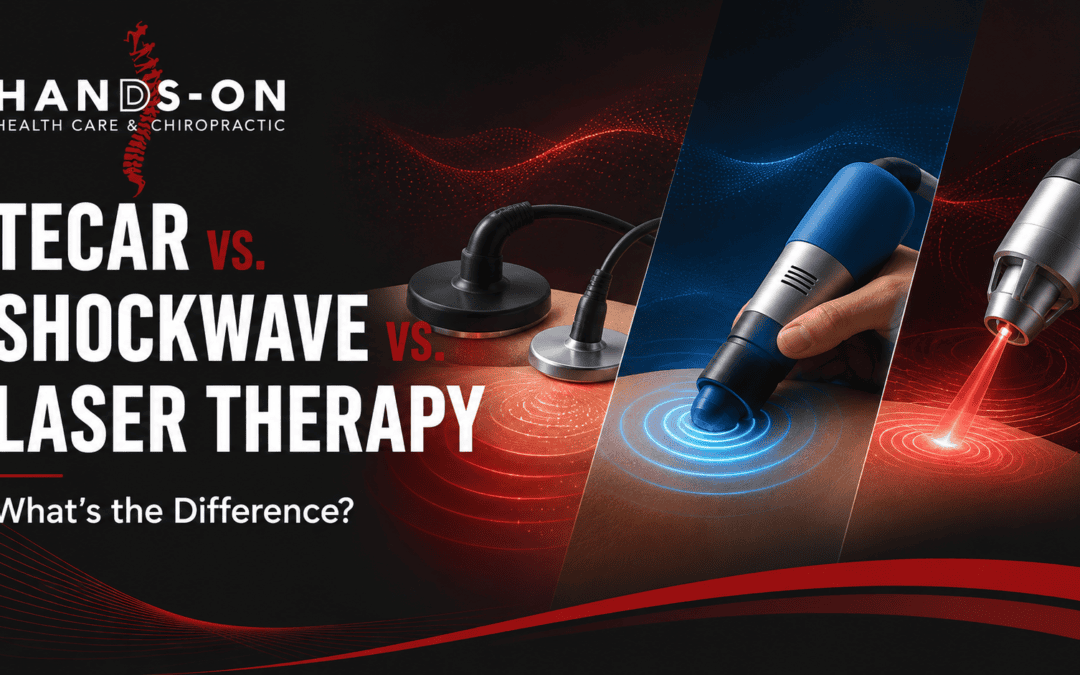
When pain, stiffness, or a musculoskeletal injury is slowing you down, it can be difficult to understand why one therapy may be recommended instead of another. This TECAR vs Shockwave vs Laser Therapy comparison explains how each therapy works and why one may be used differently from another. Winback TECAR Therapy, Shockwave Therapy, and Class IV Laser Therapy can all be used within musculoskeletal care, but they do not work the same way and should not be treated as interchangeable technologies.
Hands-On Health Care & Chiropractic offers all three therapies. Which therapy may be appropriate depends on the patient’s symptoms, treatment goals, and clinical evaluation. Winback TECAR Therapy is currently offered only at the Tarpon Springs location. Learn more about Winback TECAR Therapy.
AEO Quick Answer
TECAR, shockwave, and Class IV laser therapy use different forms of energy and may serve different roles in rehabilitation and pain care. TECAR uses radiofrequency energy delivered through electrodes and can be integrated with hands-on treatment and active movement; shockwave uses acoustic pressure waves to create a focused mechanical stimulus; and Class IV laser uses focused light to produce photobiomodulation. The right option depends on the condition being treated, treatment goals, and clinical evaluation rather than one therapy being universally “best.” FDA Winback Back 3SE documentation.
Quick Takeaways
- Winback TECAR uses high-frequency radiofrequency energy and can be incorporated into manual treatment, movement, loading, and exercise.
- Shockwave Therapy uses acoustic pressure waves applied to a targeted area.
- Class IV Laser Therapy uses focused light to produce photobiomodulation.
- The three modalities are not interchangeable, and each may fit differently into a broader care plan.
- Current research does not support a simple claim that one modality is best for every musculoskeletal condition.
- Winback TECAR Therapy is currently available at Hands-On’s Tarpon Springs location.
What Is Winback TECAR Therapy?
TECAR stands for Transfer of Capacitive and Resistive Energy. Winback describes TECAR as a high-frequency alternating current delivered through electrodes. In the FDA’s 510(k) documentation for the Winback Back 3SE, the device is classified as a radiofrequency-induced heat device intended to provide topical heating for selected medical conditions, including relief of pain and muscle spasms and increased local circulation. View the FDA documentation.
One characteristic that makes Winback TECAR particularly relevant to rehabilitation is how it can be incorporated into the treatment session. Winback’s technical information describes the system as compatible with manual soft-tissue techniques and active exercise-based rehabilitation, allowing treatment to continue while a patient moves or performs exercises. Learn about Winback TECAR technology.
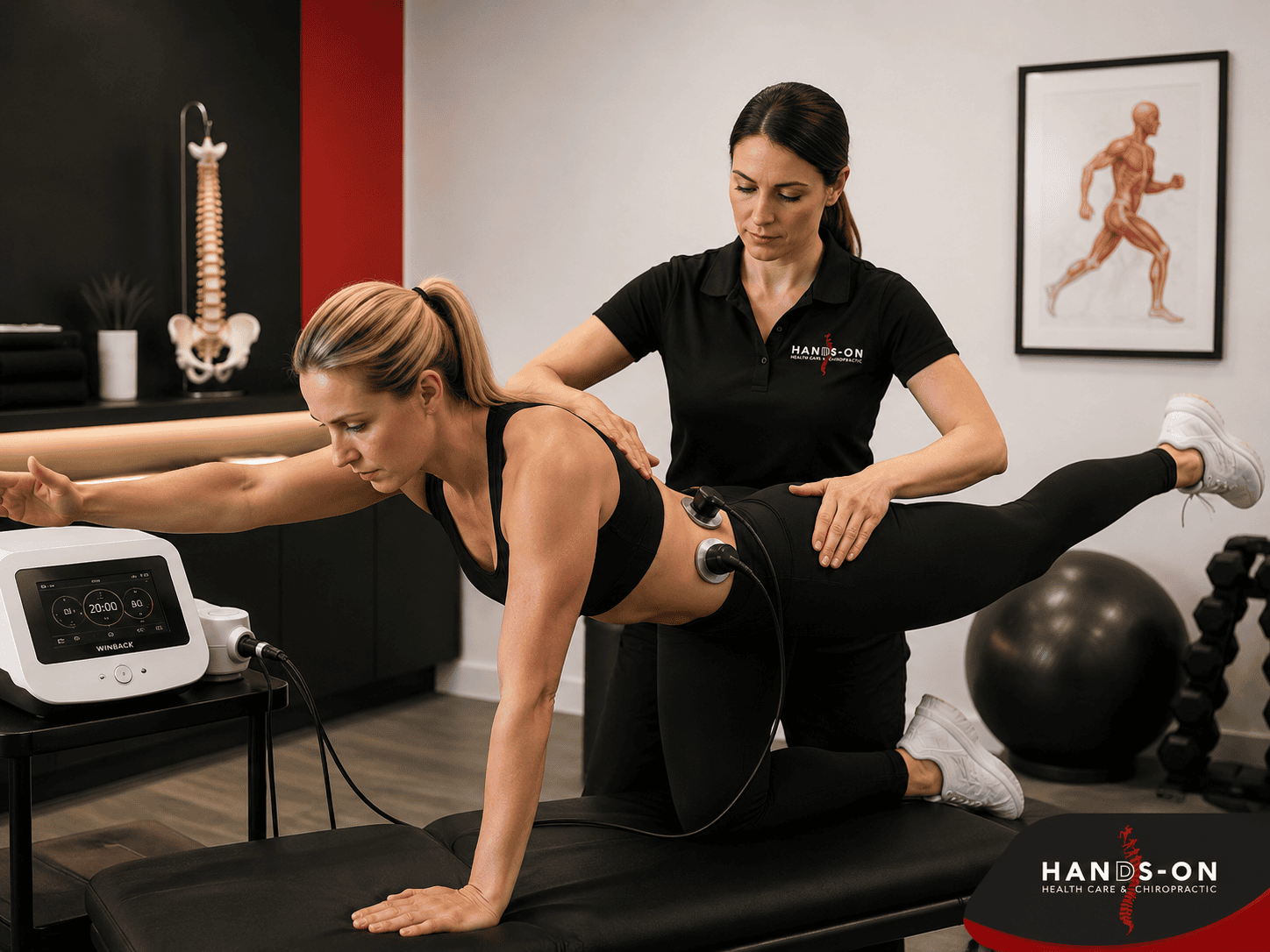
Winback TECAR Therapy can be incorporated into hands-on treatment and active movement.
That does not mean TECAR is automatically better than another modality. Instead, its delivery method may make it useful when the treatment goal includes combining a modality with hands-on work or active movement rather than using the technology only as a separate treatment step.
Research into TECAR is still developing. A systematic review and meta-analysis examining TECAR for musculoskeletal pain reported reductions in pain compared with control groups, but the included studies showed substantial variation. That is an important reason to discuss TECAR as a potential component of care rather than promising a specific outcome for every patient. Review the research on PubMed.
Learn more about Winback TECAR Therapy at Hands-On.
What Is Shockwave Therapy?
Shockwave Therapy is a non-invasive modality that applies acoustic pressure waves or pulsations to a targeted area through the skin. Hands-On describes the treatment as delivering this energy through a gel medium directly to the treatment area. Learn more about Shockwave Therapy at Hands-On.
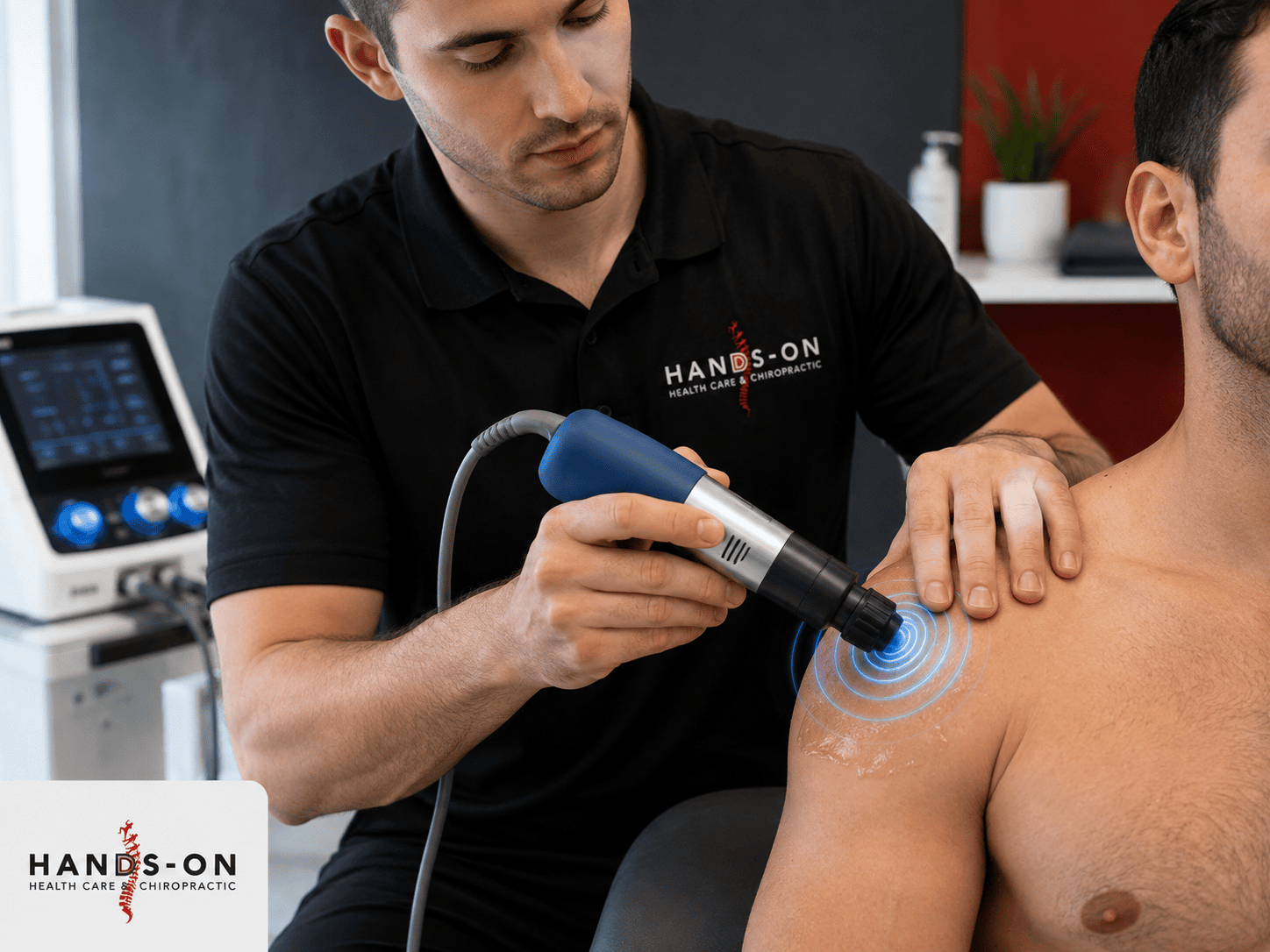
Shockwave Therapy delivers focused acoustic pressure waves to a targeted treatment area.
Because shockwave creates a mechanical stimulus, it is commonly studied in connection with certain tendon and soft-tissue conditions. However, its effectiveness is condition-specific.
A systematic review and meta-analysis examining upper- and lower-limb tendinopathies found evidence supporting shockwave for some lower-limb and calcific tendinopathies, while results were not consistently better than other treatment options for upper-limb and non-calcific tendinopathies. View the systematic review.
That distinction matters. Shockwave should not be presented as a technology that universally “breaks up scar tissue,” restores range of motion, or produces the same result for every injury. A more accurate description is that it provides a focused acoustic or mechanical stimulus that may be appropriate for certain musculoskeletal conditions after evaluation.
What Is Class IV Laser Therapy?
Class IV Laser Therapy uses focused light to produce photobiomodulation, often abbreviated PBM. Hands-On explains that photons interact with cellular processes and uses Class IV laser as a non-invasive treatment option within musculoskeletal pain and recovery care. Learn more about Class IV Laser Therapy at Hands-On.
Unlike shockwave’s mechanical pressure waves or TECAR’s radiofrequency energy, laser therapy delivers light energy directly to the treatment area through a handpiece. Hands-On’s Class IV Laser Therapy page notes that treatment is applied directly to the skin and that protective eyewear is required during treatment.
Research on high-intensity laser therapy has reported improvements in pain and function in some musculoskeletal conditions. A systematic review and meta-analysis of randomized clinical trials found improvements in pain and function, while also cautioning that study quality and risk of bias varied. Review the research.
In practical terms, Class IV Laser Therapy may be one option within a broader treatment plan, but its appropriateness depends on the condition, treatment parameters, and individual patient needs.
TECAR vs Shockwave vs Laser: How Do They Fit Differently?
The easiest way to understand these therapies is to compare the type of energy they deliver and how they may fit into treatment.
Winback TECAR Therapy
- Uses high-frequency radiofrequency energy delivered through electrodes.
- Can be incorporated into hands-on treatment.
- Can remain in use during active movement or exercise.
- May be considered when treatment goals involve pain management, mobility, or integrated rehabilitation.
Shockwave Therapy
- Uses acoustic pressure waves.
- Delivers a focused mechanical stimulus to a targeted area.
- Is applied with a dedicated treatment applicator.
- May be considered for certain tendon or soft-tissue conditions when a focused mechanical treatment is appropriate.
Class IV Laser Therapy
- Uses focused light and photobiomodulation.
- Is applied directly to the treatment area with a laser handpiece.
- Functions as a non-invasive, light-based modality.
- May be used as part of care for certain painful or musculoskeletal conditions.
The important point is that these are different tools—not competing versions of the same therapy.
Is One Therapy Better Than the Others?
Current evidence does not support declaring one of these technologies the universal winner.
A 2025 systematic review and meta-analysis directly compared extracorporeal shockwave therapy with laser therapy across 28 randomized clinical trials involving 1,460 patients. Researchers found no significant overall difference between shockwave and laser therapy for pain, strength, range of motion, or quality of life. The certainty of the evidence ranged from very low to moderate. View the 2025 systematic review.
That study did not compare TECAR against both modalities, so it would also be inaccurate to claim that TECAR is generally superior to shockwave or laser.
The better question is:
Which modality fits what the clinician and patient are trying to accomplish during this phase of care?
That distinction is especially important when comparing TECAR with the other therapies. Its ability to remain integrated with hands-on treatment and active exercise is a workflow difference, not proof that TECAR produces better results for every patient. Winback TECAR technology information.
Why Treatment Integration Can Matter
Pain care and rehabilitation are rarely about a device alone. Depending on the patient’s needs, a care plan may also involve hands-on treatment, mobility work, exercise, gradual loading, activity modification, or other approaches.
This is where Winback TECAR has a distinctive treatment characteristic.
Because its electrodes can be incorporated into manual treatment and active exercises, TECAR can move with the treatment session rather than always requiring a separate passive step. Winback specifically describes its TECAR technology as compatible with both soft-tissue management and exercise-based rehabilitation. Learn more from Winback.
For someone progressing from hands-on treatment toward movement or exercise, that flexibility may be useful.
But different does not mean better.
Shockwave may make sense when a clinician wants to provide a focused acoustic mechanical stimulus to a specific area. Class IV Laser Therapy may fit when a light-based photobiomodulation approach is appropriate. TECAR may fit when radiofrequency treatment can be incorporated directly into manual work or active rehabilitation.
The treatment plan—not the popularity of the device—should drive the decision.
How Is the Right Therapy Selected?
The appropriate modality should be based on the individual situation rather than the name of the technology.
Factors that may influence treatment selection include:
- The area and type of tissue involved
- The nature and duration of symptoms
- Current pain or sensitivity
- Mobility and activity limitations
- Rehabilitation or return-to-activity goals
- Whether treatment needs to focus on a specific area
- Whether integrating treatment with movement or exercise would support the care plan
- How the patient responds as treatment progresses
In some situations, one modality may make more sense than another. In others, different treatment approaches may be appropriate at different stages.
The objective is to choose a care strategy that fits the patient, symptoms, and goals rather than trying to make every patient fit the same technology.
How Hands-On Health Care & Chiropractic Can Help
Hands-On Health Care & Chiropractic offers Winback TECAR Therapy, Shockwave Therapy, and Class IV Laser Therapy as part of its broader musculoskeletal and pain-treatment options.
An evaluation can help determine what may be contributing to your symptoms and whether one of these therapies may be appropriate within your care plan.
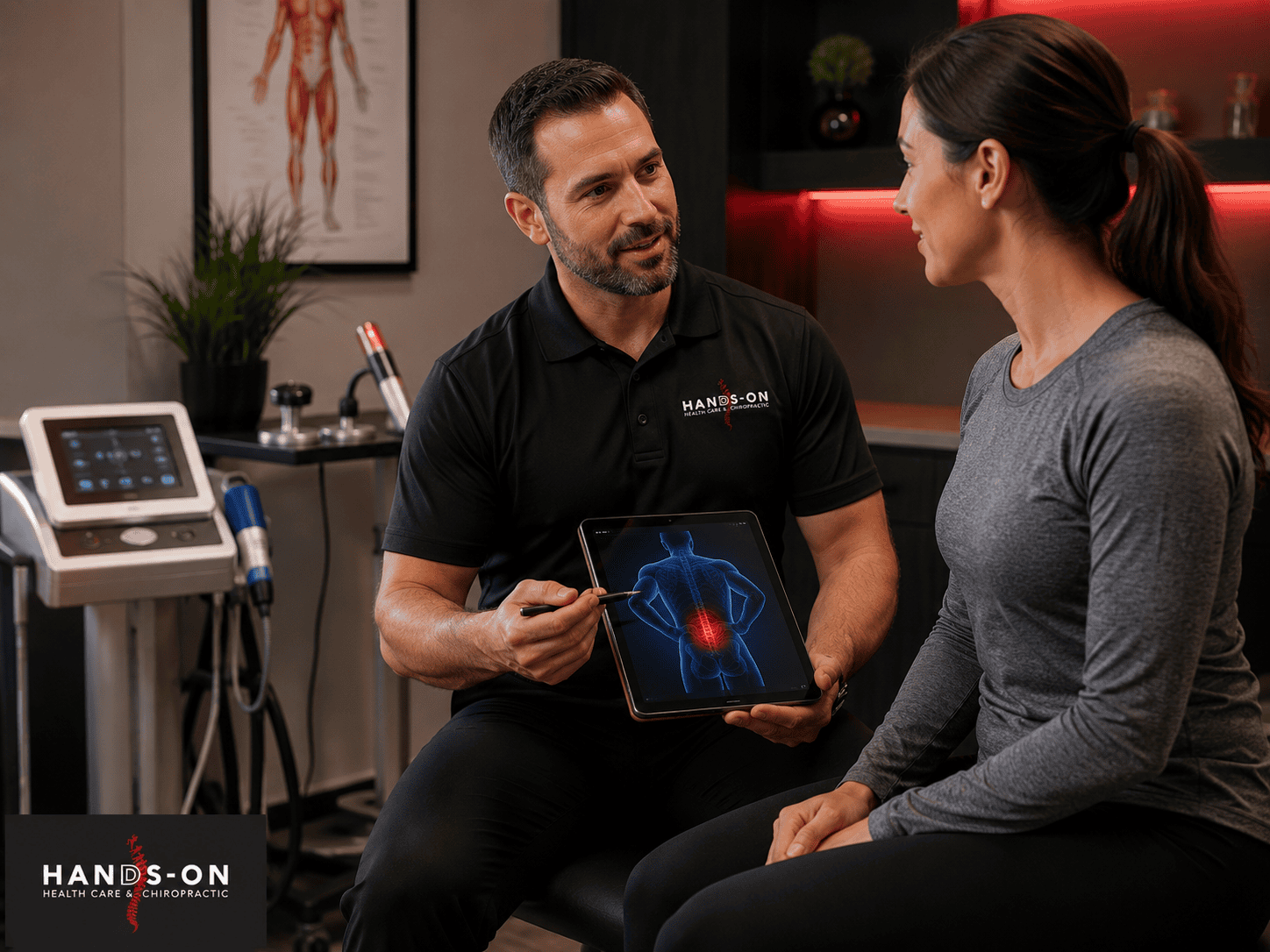
Treatment selection should be based on the patient’s symptoms, goals, and clinical evaluation.
If TECAR is being considered, remember that Winback TECAR Therapy is currently offered only at the Hands-On Tarpon Springs location.
Hands-On also serves patients at its New Port Richey location, where the team can evaluate symptoms and discuss appropriate care options.
Frequently Asked Questions
Is TECAR the same as Shockwave Therapy?
No. TECAR uses high-frequency radiofrequency energy delivered through electrodes, while Shockwave Therapy uses acoustic pressure waves to provide a focused mechanical stimulus. The two technologies work differently and may be selected for different treatment goals. FDA TECAR documentation.
Is TECAR the same as Class IV Laser Therapy?
No. TECAR uses radiofrequency energy, while Class IV Laser Therapy uses focused light to create photobiomodulation. TECAR can also be incorporated into hands-on treatment and active exercise in ways that differ from a traditional laser application. Winback TECAR technical information.
Is Shockwave or Laser Therapy better for pain?
There is no universal answer. A 2025 systematic review comparing shockwave and laser therapies found no significant overall difference in several major outcomes, including pain. The appropriate choice depends on the condition, treatment goals, and clinical evaluation. View the research.
Can TECAR be used during exercise or movement?
Yes. Winback’s technical materials specifically describe TECAR as compatible with active exercise-based rehabilitation as well as manual treatment. This ability to remain integrated with movement is one of the main ways TECAR can differ from modalities that are generally delivered as dedicated treatment applications. Learn about TECAR integration.
Where is Winback TECAR Therapy available at Hands-On?
Hands-On’s official Winback TECAR Therapy page states that the service is currently offered only at the Tarpon Springs location.
Ready to Find the Right Treatment Approach?
If pain, stiffness, or an injury is limiting your movement, you do not need to decide which technology you need before your visit.
A clinical evaluation can help determine which treatment options may fit your symptoms, activity level, and goals.
Schedule an appointment with Hands-On Health Care & Chiropractic to discuss your care options. If you are specifically interested in Winback TECAR Therapy, schedule with the Tarpon Springs location.